

Cash Jar - Win Real Money Easy
SpinZ Gaming LLC
I tried Cash Jar - Win Real Money Easy as a small, casual reward game rather than treating it like a serious income tool. Its basic appeal is easy to understand: open the game, tap, collect progress, and return later when another cash-out opportunity becomes available. That simple loop makes it approachable, especially for short breaks, but it also means the experience depends heavily on your expectations. I would describe it as a light, repeatable activity with a rewards angle, not a replacement for work or a dependable way to earn money.
The game comes from SpinZ Gaming LLC and sits in the casual games category. It is free to download, has a Teen content rating, and requires Android 8.0 or later. The current release is version 1.0.9. Those details make it accessible on many older Android phones, although the age rating is important if the device is shared with younger people. The game has reached over 100 thousand installs and carries an average rating of 4.9 from around 2 thousand ratings, so there is clear interest in its straightforward format.
How Cash Jar Works on a Shared Device
The most realistic household use is not a group playing together at the same time. Instead, one person may keep the game on a family tablet or a phone that several people use during the day. One person taps for a while, another checks it later, and someone else may open the app without realizing that the progress belongs to the first player. That makes account boundaries more important than the simple controls initially suggest.
On my first sessions, the tapping mechanic felt immediately understandable. There is no lengthy tutorial to decode before getting started, and the store summary accurately reflects the central rhythm: tap for rewards and return for another cash-out opportunity every three hours. The simplicity is a strength when I only have a spare minute, but it can become repetitive if I expect the variety found in a larger casual game.
For a shared device, I would decide in advance who owns the game session. If the app is installed on a personal phone, that boundary is easy. On a household tablet, I would avoid letting several people treat the same progress as communal unless everyone understands that taps and reward activity may be mixed together. A child tapping through someone else’s session can create confusion, while an adult assuming the game is reset may accidentally interrupt the routine.
Related News






A useful everyday scenario is a shared tablet in the kitchen. One adult checks the game during a coffee break, leaves it alone, and another household member uses the tablet later for a different task. When the first person returns, the important question is not who tapped most recently; it is whether the same player is still managing the rewards. I found that a simple verbal agreement works better than assuming the device itself will organize separate users.
Keeping setup simple without blurring ownership
Because Cash Jar is free, the initial decision is less about purchase risk and more about how you want to use it. I would install it on the device belonging to the person who plans to play, rather than placing it automatically on a shared screen. That keeps the reward routine personal and reduces the chance that someone else opens the game casually and changes the state of the session.
If you do use a shared device, create a small routine before playing. The person who starts the game should be the person who checks the reward cycle and handles any cash-out action. Other household members can still try the tapping loop, but they should know that their activity may not represent a separate profile or a separate balance. The safest household rule is to treat one installation as one player’s space unless the game clearly provides separate account handling.
Gallery
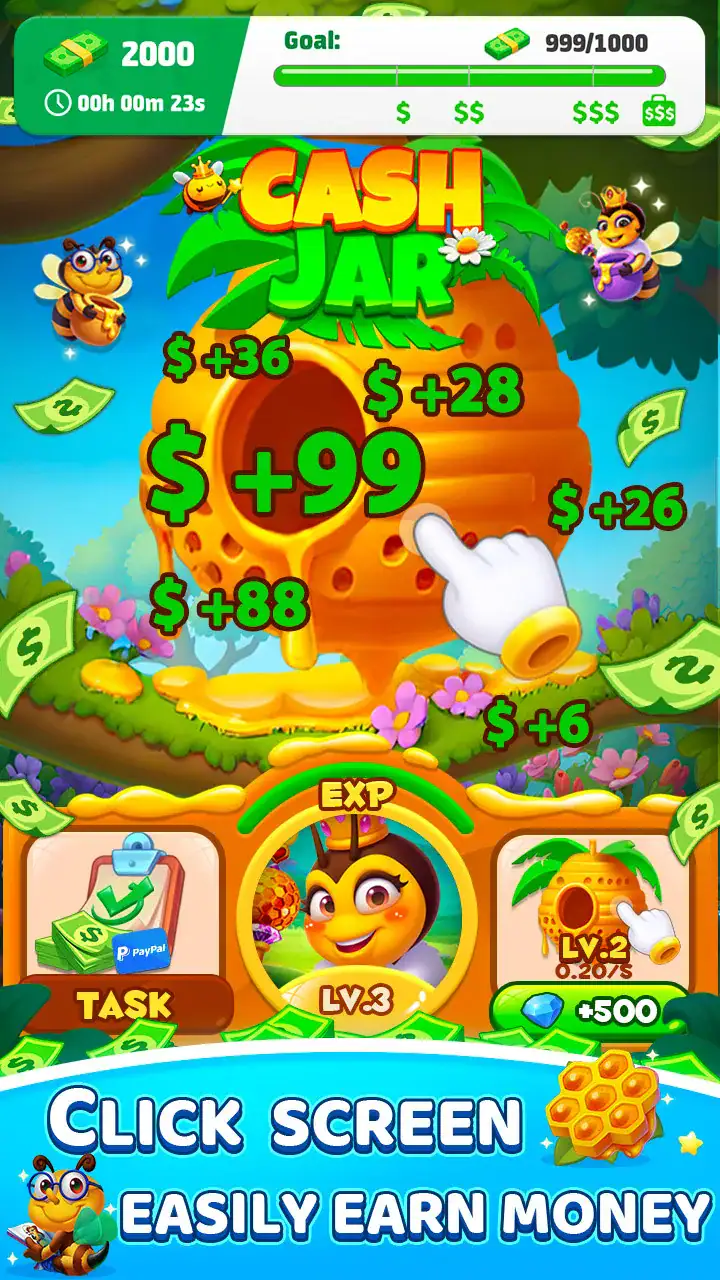
I would also avoid handing the device to a child simply because the controls look harmless. The Teen rating means the game should be considered in an age-appropriate context, particularly because reward and cash-out language can make a casual activity feel more financially significant than it really is. The tapping itself is easy; understanding what a reward means, when it can be collected, and what expectations are reasonable requires more maturity.
Another practical point is timing. The three-hour return window encourages checking the app repeatedly, but a household should not organize its day around it. I prefer treating the next available opportunity as something to notice when convenient, not as an appointment. If the game starts competing with schoolwork, meals, sleep, or normal family routines, its low-effort design stops being an advantage.
Coordinating rewards and expectations
The phrase “cash out” can create a stronger expectation than the actual play experience deserves. I approached the game with the assumption that tapping would be entertaining first and financially meaningful only if the full reward process proved worthwhile. That mindset matters because a free casual game can be pleasant for a few minutes while still being a poor choice for anyone seeking predictable earnings.
In a shared household, agree on what “playing” means. Is one person collecting the reward, or is the game merely available for anyone to try? If the answer is unclear, a teenager might tap for amusement while an adult later assumes the activity was being managed toward a cash-out. I would keep the arrangement explicit and avoid promising anyone a particular amount or result.
The three-hour cycle also creates a coordination issue when more than one person wants to use the app. If the device is shared, the person who started the cycle may feel they need to return at the right moment, while another user may not know that. A simple note or spoken reminder can prevent arguments, but that is also a sign that the game is better suited to one regular player than to a busy household with competing schedules.
My practical tip is to test the routine during an ordinary day rather than during a quiet weekend. Open the game when you would normally have a short break, then see whether returning later feels natural or intrusive. This reveals more than a long first session because the main trade-off is not learning the controls; it is deciding whether the repeating check-in fits your life.
For adults who enjoy small digital reward loops, that structure can be satisfying. I like the feeling of having a quick activity that does not require planning a level, learning a complicated rule set, or committing to a long match. For someone who prefers changing challenges, strategy, or a clear sense of progression, the same structure may feel thin very quickly.
Trust, age, and the meaning of “real money”
I would be careful about presenting Cash Jar to a younger player as a way to make money. The Teen content rating should be taken seriously, and the financial wording deserves an adult explanation. A responsible conversation would cover the difference between tapping for in-game rewards and receiving dependable income. It should also make clear that no one should share personal or payment information casually just because an app mentions cash-out.
That advice is especially relevant on a shared phone. If an adult handles the reward process, a child should not be asked to enter account details, approve transactions, or make decisions they do not understand. I would keep ownership of the device session and any financial step with the adult, while allowing the younger person to decide whether the tapping itself is enjoyable and age-appropriate.
Trust also affects whether the game feels comfortable in a family setting. A parent may want to know why the app is being opened repeatedly, while a teenager may see it as no different from another casual game. The best approach is not to overstate the opportunity. Explain that the game offers a reward-focused loop, set a time boundary, and make it clear that the household budget should never depend on it.
I would also skip the game for anyone who is easily drawn into repeated checking or who feels pressure to maximize every available opportunity. The three-hour rhythm is gentle compared with more aggressive game systems, but even a simple return loop can become distracting when the reward language is the main reason for opening the app. A conventional offline puzzle or a casual game without a money-related expectation may be a better fit in that situation.
What the free model is good at—and where it falls short
Being free makes Cash Jar easy to try without committing money upfront. That is useful for a curious adult who wants to understand the loop before deciding whether it deserves a place on the phone. It also suits people who prefer very short sessions and do not want a game that demands fast reactions or a complicated strategy.
The limitation is that “free” does not automatically mean frictionless. The value of the experience depends on how the reward process feels over time, how often you are willing to return, and whether the cash-out goal matches your expectations. I would not install it with the assumption that a few taps will produce a meaningful financial result. The better test is whether the tapping remains mildly enjoyable even when the reward is treated as a bonus.
Compared with a standard idle game, Cash Jar adds a practical motivation through its reward language and three-hour timing. Compared with a puzzle game, it offers less mental variety and probably less satisfaction for players who want to solve something new each session. Compared with ordinary survey or cashback services, it is more game-like and less task-oriented, but it may not suit someone who wants a clear exchange of effort for a clearly defined benefit.
That comparison helped me place it correctly. I would choose Cash Jar over a more demanding game when I want a tiny, low-pressure distraction. I would choose a puzzle or arcade title when I want entertainment that stands on its own. I would choose a conventional financial or cashback service when my priority is tracking a transaction or saving money rather than tapping through a casual loop.
Who should install it and who should pass
Cash Jar is a reasonable choice for an adult who enjoys simple interactions, likes checking a game occasionally, and can keep the reward promise in perspective. It may also work for a household where one person clearly owns the session and everyone else understands that the app is not a communal bank or a guaranteed source of money.
I would pass if you need deep gameplay, offline entertainment with no reward-related expectations, or a predictable financial return. I would also pass for a young child, for a shared device with no agreement about ownership, or for anyone who tends to treat cash-out wording as a promise of income. The Teen rating and the financial theme make supervision and explanation more important than the uncomplicated controls might suggest.
One non-obvious strength is that the game’s simplicity makes it easy to evaluate honestly. You do not need to learn a complex system before deciding whether it fits. Give it a few ordinary check-ins, observe whether the repetition bothers you, and judge the reward loop by how it affects your attention rather than by the excitement of the first session. That is a more useful test than tapping continuously for a long stretch.
Another trade-off is device responsibility. A personal phone makes the experience cleaner because the player, timing, and reward decisions stay together. A shared tablet makes the game socially accessible but introduces ambiguity. In my view, the household should prioritize clear ownership over convenience; otherwise, the app can create more discussion about who did what than enjoyment.
My household verdict
After using Cash Jar as a casual reward game, I see its appeal clearly. It is approachable, free, and built around a routine that takes very little effort to understand. The current version, 1.0.9, presents a focused experience rather than a broad collection of activities, which is exactly why some players will appreciate it and others will move on quickly.
I would recommend it to an adult friend who wants a lightweight tapping game and is comfortable treating any reward as secondary to the activity. I would suggest installing it on that person’s own phone, setting sensible limits, and explaining the Teen rating before sharing it with a younger household member. On a communal device, I would use it only when everyone agrees who is responsible for the session and any cash-out step.
My final view is positive but measured: Cash Jar works best as a small, occasional distraction, not as a household income plan. Its high average rating and growing install base show that the concept connects with many users, yet the right audience is still fairly specific. If you want a simple routine with a reward theme, it is worth trying. If you want rich gameplay, guaranteed earnings, or completely clear separation between several players on one device, another option will serve you better.
FAQs for Cash Jar - Win Real Money Easy
What is Cash Jar - Win Real Money Easy, and how does it work?
Cash Jar - Win Real Money Easy is a rewards-style mobile app that may let users collect points or virtual earnings by completing activities such as viewing offers, answering questions, playing games, or participating in promotional tasks. After reaching the required withdrawal threshold, eligible users can request a payout through the payment methods supported in their region. Available tasks and rewards can change frequently.
Can you really withdraw real money from Cash Jar - Win Real Money Easy?
The app presents itself as a way to earn real rewards, but users should not assume that every displayed balance can be withdrawn immediately. Cash-out eligibility may depend on reaching a minimum amount, completing verification, following promotional rules, and living in a supported country. Before spending significant time in the app, review its current withdrawal conditions, processing times, and user feedback.
How much money can users earn with Cash Jar - Win Real Money Easy?
Earnings are generally modest and depend on the number of available tasks, your location, time spent, account eligibility, and the reward rates offered by advertisers or partners. This type of application should be viewed as a casual rewards platform rather than a dependable income source. Some users may find opportunities regularly, while others may see limited tasks or low-value rewards.
Is Cash Jar - Win Real Money Easy safe to use?
Safety depends on the permissions requested, the information collected, and the third-party offers displayed inside the application. Install it only from an official store, check the developer details, and avoid providing unnecessary sensitive information. Be cautious with offers that request payment, banking credentials, or excessive permissions. Reading the privacy policy and reviewing recent ratings can help you make a more informed decision.
What should I do if my withdrawal is delayed or rejected?
First, confirm that your account has met every cash-out requirement, including the minimum balance, identity checks, offer completion rules, and any regional restrictions. Check whether the payment method and account details are correct, then allow the stated processing period to pass. If the problem continues, contact support through the app and keep screenshots or transaction details. Never pay an extra fee simply to unlock a withdrawal.
Pros
- Simple cash-reward concept that is easy for beginners to understand.
- Short tasks and games can fit conveniently into spare moments.
- Clear reward progress helps users track their potential earnings.
- No advanced skills are needed to start completing available activities.
- Lightweight design should run smoothly on many modern devices.
Cons
- Earnings may be small compared with the time required to complete tasks.
- Reward availability can vary by country
- account
- and current promotions.
- Some offers may redirect users to external websites or partner apps.
- Cash-out requirements may include minimum thresholds or verification steps.
- Frequent ads can interrupt gameplay and reduce the overall experience.


